If you own land you cannot do a thing with, start here
If you own a vacant lot or a few acres somewhere in Charleston, Dorchester, or Berkeley County and you are about ready to be done with it, you have plenty of company. The tri-county is full of folks sitting on land they inherited, land they bought back when it was cheap, or land they have honestly never laid eyes on.
Here is what nobody tells you up front: selling vacant land in South Carolina does not work anything like selling a house. Three reasons, and all three of them matter.
- There is no easy comp. Two parcels on the same road can be worth wildly different money depending on whether a truck can get to them and whether anything will drain.
- Your buyer probably cannot get a loan. Banks do not like raw land. That shrinks your buyer pool down to cash buyers and people who need terms.
- Most agents do not want the listing. It is not personal. The math just does not work for them, and I will show you why in a minute.
So this page is not a pitch. By the time you get to the bottom, you should know roughly what your parcel is worth, why it has been such a chore to move, what the closing is going to cost you here in South Carolina, and what you would actually walk away with under each of the five ways to sell it. There is a table with real numbers about halfway down.
I buy land in these three counties, so I will tell you plain that I have a dog in this fight. I have also put a whole section in here on when you should not sell to somebody like me. Read that part too.
What is your land actually worth?
This is the question you came here for, so let us start there instead of making you scroll.
The honest answer is that nobody can tell you over the phone, and anyone who does is guessing. But you can get yourself in the right ballpark in about twenty minutes, for free, and I will walk you through exactly how.
Why that price per acre you saw online is lying to you
Folks look up land listings, see a number, divide by acres, and figure that is their answer. It is not even close.
Pull up Charleston County land listings and you will see an acre on Johns Island asking somewhere around $60,000 an acre, while a little tenth-acre lot in North Charleston works out to over a million dollars an acre on paper. Head out toward Harleyville in Dorchester County and you can find eight and a half acres listed for about $115,000. Same general area, same market, numbers that have nothing to do with each other.
Price per acre is not a measurement of land. It is a measurement of what somebody can build on it and how soon. Small lots in town carry a huge per-acre number because the lot is worth whatever a house on it is worth. Big rural tracts carry a small one. Averaging across them tells you nothing about your place.
The five things that really set the price around here
1. Can a vehicle get to it legally? Not “is there a path.” Is there deeded, recorded legal access from a public road. A landlocked parcel with no easement is worth a fraction of the same parcel with frontage, and this is the single most common reason a tri-county parcel will not sell.
2. Are utilities at the road? Power is usually the easy one. Water and sewer are the expensive ones. If county water and sewer run past the front of your parcel, you are in good shape. If they stop a half mile up the road, somebody is paying to bring them, and that somebody is reflected in your price.
3. Wetlands and flood zone. This is the Lowcountry, so this one bites. A parcel can be perfectly dry looking in October and be standing water in March. Wetlands are not a dealbreaker on their own, but they shrink the buildable footprint, and the buildable footprint is what you are really selling.
4. Zoning and minimum lot size. Five acres zoned for one house per three acres is a different animal than five acres you could split. Zoning is also the thing most owners have never once looked up.
5. Will it pass for septic? If there is no sewer, your buyer needs an onsite wastewater permit, and that comes down to soil. South Carolina requires a soil evaluation before any new septic permit, and the state inspector comes out and looks at soil type to decide whether the land can support a system at all. The Lowcountry counties, Charleston and Dorchester included, are the hardest ground in the state for this.
One detail worth knowing, straight from the state: a site can pass a perc test in a dry stretch and fail in a wet one, and South Carolina has sites that passed and then ended up with systems that did not work right come the rainy season. So “it perced in 1998” is not the same as “it will permit today.”
If your land is in the country with no sewer, this question is worth more to your price than anything else on this list. You can get ahead of it: the state will issue a preliminary tract evaluation to tell you whether a tract is conceptually suitable for onsite wastewater before anybody plans a house. A seller who walks up with that in hand is a seller who gets taken seriously. How the site inspection works and Clemson’s plain-English walkthrough of the permit process are both worth ten minutes.
How to look up your own parcel in about twenty minutes
You need your TMS number first. That is the tax map number, and it is printed right on your property tax bill. If you cannot find the bill, the county assessor can pull it up by your name or the address.
Then, with that number in hand:
- Pull your parcel on your county’s GIS viewer. All three counties have one, and all three are free. Charleston County goes through the Assessor and the county GIS viewer, Dorchester County has a GIS property search on the county site, and Berkeley County’s real property and GIS departments have theirs. Search by TMS. You will get acreage, the zoning code, the assessed value, and usually an aerial photo.
- Turn on the layers. The good county viewers will overlay wetlands, flood zones, soils, and sometimes topography right on top of your parcel. This is the part most owners never do, and it is where the real answers are.
- Check the flood zone separately on the FEMA flood map viewer, because flood maps get updated and the county layer may be behind.
- Look at your last tax bill. Your county’s appraised value is not market value and it is often well behind, but it tells you what the county thinks and it is a floor to argue from.
- Call the county planning or zoning desk and ask one question: “What could somebody build on TMS number such and such?” They will tell you. It is a public question and they answer it every day.
That is it. No cost, no appointment, no commitment to anybody. Twenty minutes and you know more about your parcel than the last three people who mailed you a letter about it.
Why your tax bill feels so high for a piece of dirt
Quick side note, because this one makes people mad and it helps to know it is not a mistake.
South Carolina taxes property at different ratios depending on use. An owner-occupied home gets assessed at 4 percent of fair market value. Vacant land gets assessed at 6 percent. On top of that, owner-occupied homes are exempt from the school operating portion of the bill, which in most counties is the biggest single piece of the millage.
So you are paying a higher ratio and you are paying the school millage that a homeowner down the road does not pay. That is why a vacant lot can feel like it is taxed harder than a house. It is working exactly as written. (SC Department of Revenue, Individual Property Taxes)
Why nobody wants to list your land
If you called a couple of agents and never heard back, or you listed it and it just sat there, I want you to know that is not a reflection on you or your property. There are three real reasons, and once you see them the whole thing makes sense.
Reason one: the commission math does not work for an agent
Run the numbers on a small parcel. Say your lot is worth $30,000 and the commission works out to 6 percent, which gets split between two brokerages and then again with the agents. Your listing agent might clear a few hundred dollars.
For that few hundred dollars they are going to field questions about easements, figure out the zoning, explain to three different buyers why their bank said no, and hold the thing for the better part of a year.
Meanwhile a house across town pays them twenty times that for less work. They are not being lazy or rude. They are being rational, and commission rates are negotiable anyway, so there is not much room to sweeten it on a small tract.
This is why land agents who do take small listings often want a flat fee up front, and why the good land brokers around here mostly work tracts over a certain size.
Reason two: land sits, and sits, and sits
Houses move reasonably quick in this market. The median Charleston home sale runs about 97 days from listing to closing, which breaks down to roughly 68 days to get under contract and another 29 to close.
Land is a different story. One one-acre vacant lot over in Dorchester County went under contract after about nine and a half months on the market. That is not unusual for land. That is Tuesday.
If your listing expired and you took it as a sign that something is wrong with your parcel, it may just have been a sign that land takes longer than a listing agreement lasts.
Reason three: your buyer cannot get a mortgage
This is the big one and almost nobody explains it.
Banks do not like lending on raw land. There is no house to foreclose on, no rental income, and no easy way to value it. The lenders who will write a land loan typically cap it around 70 percent of the purchase price or value on raw land, and plenty of them will not touch it at all.
Think about what that does to your buyer pool. A regular buyer with good credit and 5 percent down can buy a house. That same buyer cannot buy your land. What is left is people paying all cash and people who need the seller to carry the note.
That is the whole reason the land market works the way it does around here, and it is the reason section seven of this page exists.
Which one of these is you?
Most people who end up on this page fall into one of six situations. Find yours and there is a full write-up waiting on it.
“I inherited it and I never wanted it”
The most common one by a mile. Mama or Granddaddy left the land, you live three states away, and now you are paying taxes on a piece of Dorchester County you have seen twice.
First thing to sort out is whether you actually have the legal authority to sell yet, which depends on whether the estate went through probate and what the deed says now. Good news on the tax side: South Carolina has no state estate tax and no inheritance tax.
“It is in the family’s name and we cannot all agree”
When land passes down without a will, or with a will that leaves it to several people without dividing it up, the heirs end up owning it together as tenants in common. Everybody owns an undivided share and nobody owns a piece they can point to. Around here that is called heirs’ property, and in the Lowcountry it is extremely common.
If this is your situation, please read that write-up before you talk to any buyer, me included. There are free and low-cost resources in Charleston whose whole job is helping families clear title and keep the land, and sometimes keeping it is the right answer.
“The taxes are stacking up and I am worried about losing it”
This one has a clock on it, so let me give you the important part right here.
In South Carolina, unpaid property taxes become a lien and the county can sell the property at a delinquent tax sale. But the winning bidder does not get your land that day. You get a twelve-month redemption period after the sale to pay it off and keep your property, and during that redemption period you still own it and still have possession. The interest you owe to redeem climbs on a schedule, from 3 percent of the bid in the first three months up to 12 percent in the last three.
So if your parcel has already gone to tax sale, you very likely still have time. Call the county tax collector and ask for the exact redemption figure. (SC Code 12-51-90, and Nolo’s plain-English summary)
“I have never actually seen the place”
Plenty of tri-county land is owned by folks in Ohio, New York, or California who bought it, got it in a divorce, or inherited it and have never set foot on it. You can absolutely sell land you have never visited, and South Carolina closings can be done by mail.
The thing to watch is that you have no idea what is actually on your parcel right now, and that matters. Dumping, a neighbor’s fence in the wrong spot, a timber cut, a road somebody put in.
“I listed it and nothing happened”
See the section above about how long land sits. Nine months to a year is normal, not a verdict on your property. Before you relist it, it is worth finding out which of the five value factors is the one holding you up, because fixing one of them is sometimes cheaper than dropping the price.
“I do not think anything can be built on it”
No road access, wetlands across most of it, failed soil evaluation, or a lot so small that current zoning will not let anybody build. These parcels are the hardest to sell and the ones most likely to get a lowball letter in the mail.
They are not worthless. They are worth something specific to a specific buyer: the neighbor who wants a bigger yard, a hunter, somebody assembling tracts, or a conservation group.
Your five real options, and what you actually walk away with
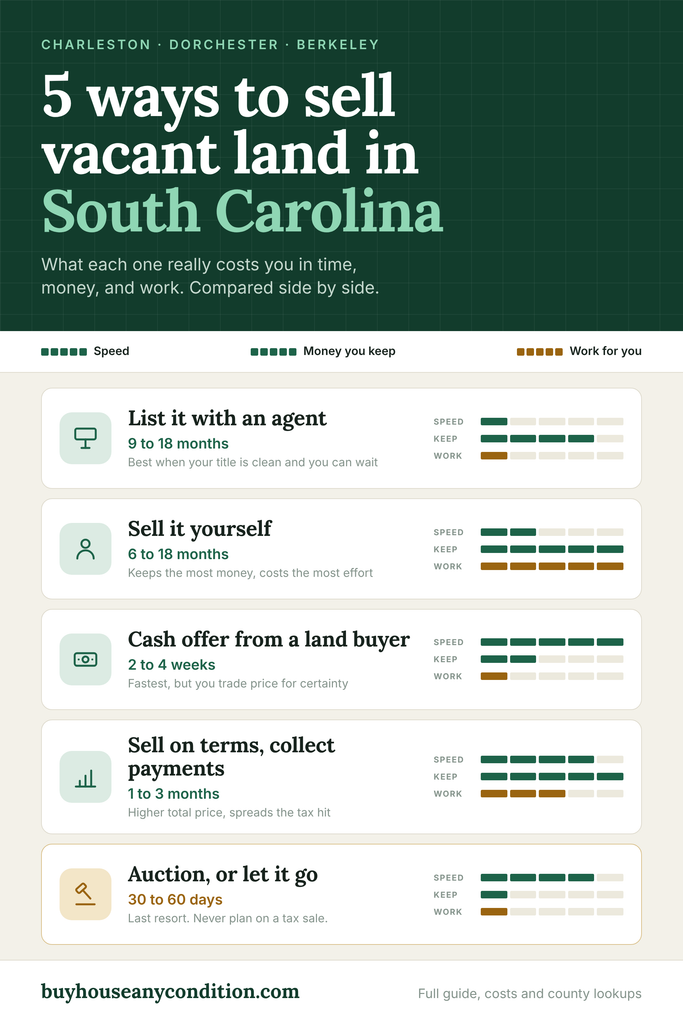
Here is the part I wish somebody had handed me the first time I sold a piece of land. Five ways to get it done, side by side, with the money laid out honestly.
The example below runs on a $40,000 parcel because that is a pretty typical tri-county tract. Scale it to yours.
Charleston · Dorchester · Berkeley County
Five ways to sell your land, side by side
Same parcel, five routes, very different outcomes. The gauges show the trade-off at a glance. The numbers below each one are the real detail.
List it with an agent
- How long
9 to 18 months is realistic for land
- Off the top
Commission, around $2,400 on a $40,000 parcel at 6 percent, and it is negotiable. Plus closing costs.
- Work for you
Low once it is listed. You just wait.
Right when Your title is clean, you have legal access, you are in no hurry, and you can keep paying the taxes while it sits. This route nets you the most money.
Sell it yourself
- How long
6 to 18 months, however long your patience holds
- Off the top
No commission. You pay for the listing sites, the signs, and your own time fielding calls.
- Work for you
High. You are the agent now.
Right when You are organized, you are local enough to meet people out at the property, and you want that commission in your own pocket.
Cash offer from a land buyer
- How long
2 to 4 weeks, sometimes less
- Off the top
A discount off market value. That discount is the whole trade. Insert your actual range
- Work for you
Almost none. Sign and close.
Right when You need it gone, or the parcel has a problem that scares retail buyers off: no access, wet ground, title trouble, or taxes with a clock on them.
Sell on terms and collect payments
- How long
1 to 3 months to find the buyer, then payments for years
- Off the top
Nothing comes off the top, but you carry the risk of the buyer quitting on you.
- Work for you
Medium up front, then you are collecting payments.
Right when You do not need the lump sum, you want a higher total price, and you would rather spread the tax hit across years than take it all in one.
Auction, or let it go
- How long
An auction runs 30 to 60 days. A tax sale takes care of itself.
- Off the top
Auction fees. Or, in a tax sale, everything above the taxes you owed.
- Work for you
None.
Right when The parcel genuinely has no value to anybody and you just want to stop paying taxes on it. Read the warning first.
Do not let land go to tax sale as a plan. If it sells for more than you owe, that surplus is supposed to come back to you, but you have to claim it and plenty of folks never do. You also take the record and credit consequences for nothing. Almost every other option on this page beats walking away.
A word about that last row
Do not let land go to tax sale as a strategy. If the parcel sells at the tax sale for more than you owe, that surplus is supposed to come back to you, but you have to claim it, and plenty of folks never do. You also eat the credit and record consequences for no reason. Almost anything on this list beats walking away.
Working the numbers on that $40,000 parcel
Take the agent route. On a $40,000 sale in South Carolina:
- Deed recording fee: $1.85 for each $500 of value. That is 80 increments, so $148, plus a $15 filing fee. The state keeps $1.30 of each $1.85 and the county keeps $0.55. By custom the seller pays this one, though it can be negotiated. (SC Department of Revenue)
- Closing attorney: required in South Carolina, see the next section. Get two quotes from local firms, and tell them it is a simple cash land closing with no loan, because that is a cheaper file than a house with a mortgage.
- Survey: only if you need one. Cost depends on acreage, terrain, and how bad the old description is. A small cleared lot is a few hundred. Forty wooded acres with a vague deed is a different conversation.
- Prorated property taxes: you cover the portion of the year you owned it.
- Commission: at 6 percent, $2,400.
So on a clean $40,000 listing you are looking at roughly $2,400 in commission and a few hundred to a couple thousand in closing costs, depending on the survey. Call it somewhere in the neighborhood of $36,000 to $37,000 in your pocket, nine months to a year and a half from now, assuming it sells at ask.
That last clause is doing a lot of work, and that is the honest comparison against a cash offer that closes in three weeks. One is more money later and maybe. The other is less money now and for certain. Which one is better depends entirely on your situation, and anybody who tells you there is a universal right answer is selling you something.
What selling actually costs here in South Carolina
If you have read advice about selling land from a national website, throw most of it out. South Carolina does a couple of things its own way, and they both affect your bottom line.
You cannot close without a lawyer, and that is not negotiable
In a lot of states you can close a land sale at a title company. Not here.
The South Carolina Supreme Court settled this back in 1987 in a case called State v. Buyers Service, and it has been the law ever since: real estate closings in South Carolina have to be conducted under the supervision of an attorney. The court has identified the pieces of the transaction that count as practicing law and therefore require a South Carolina lawyer, including the title search, preparing the documents, the closing itself, recording, and disbursing the money. (SC Bar Ethics Advisory Opinion 05-16, and the Bar’s opinion 09-01 listing all five components)
Two practical things follow from that.
First, budget for a closing attorney, and shop it. A simple cash land closing with no mortgage is a much lighter file than a house purchase with a loan, and the fee should reflect that. Call two or three firms and say exactly that.
Second, that attorney is a feature, not a tax. On a land deal where the title history is murky, where there might be an old family interest nobody cleared up, or where the access easement is unrecorded, having a lawyer do a real title search protects you from selling something you cannot actually deliver. I have seen deals die at the closing table over a 1962 deed. Better to find that in week one.
You can close by mail, by the way, which matters if you are out of state. The Bar has specifically addressed that a closing can be handled by mail with the client not physically present.
The deed recording fee, which everybody calls deed stamps
South Carolina charges a deed recording fee when property changes hands. It works out to $1.85 for every $500 of value, or any fraction of $500, which is about 0.37 percent of your sale price. Of that, $1.30 goes to the state and $0.55 stays with the county. There is also a $15 filing fee for the deed itself. By custom the seller pays it, though who pays is technically negotiable. (SC Department of Revenue)
Quick math so you do not have to: $20,000 is $74. $40,000 is $148. $100,000 is $370.
Worth knowing if you inherited: a deed releasing real property to the distributees of a deceased person’s estate is exempt from the deed recording fee. So getting the land out of the estate and into your name does not cost you that fee. Selling it afterward does. (Lincoln Institute summary of the SC transfer charge)
Survey
Not always required, but often a good idea on land, and sometimes the buyer will insist. The cost scales with acreage, how thick the woods are, and how bad the existing legal description is. A small cleared lot in a platted subdivision is cheap. A large irregular tract described by reference to a neighbor’s fence line and an oak tree is not.
If you are selling to an investor, ask whether they will pay for the survey. Many of us will, because we want it anyway.
Prorated property taxes
You pay for the slice of the year you owned it, the buyer picks it up from closing. The attorney handles the proration. If you are behind on taxes, the back taxes come out of your proceeds at closing, which is actually a clean way to resolve them.
What you do not pay
No state estate tax. No state inheritance tax. No real estate transfer tax beyond the deed recording fee above. Some municipalities that had a transfer fee in place before 1991 can still collect one, so ask if your parcel is inside city limits.
The honest version of a cash offer
You have gotten the letters. “We buy land, any condition, close in two weeks.” I send letters like that, so let me just tell you how it works from the inside.
Why the offer is below market, and where that money goes
A cash offer on land is discounted. Anybody who tells you otherwise is lying to you. The discount is the price of speed and certainty, and here is honestly what it pays for:
- Carry. Whoever buys your parcel is going to own it for a good while, because land takes nine months to a year and a half to resell. That is taxes, insurance, and money tied up the whole time.
- Risk on title and access. The buyer is taking on whatever is wrong with the deed, the easement, or the boundary. Sometimes that is nothing. Sometimes it is a title action and two years.
- The cost of finding the next buyer. Marketing, listing fees, surveys, brush clearing so somebody can actually walk it.
- Being wrong. Some parcels turn out worse than they looked. That gets priced in across all of them.
- Profit, which I am not going to pretend is not in there.
That is the real list. If the discount a buyer is asking for looks a lot bigger than that list justifies, it is a lowball.
How to tell a fair offer from a lowball
You do not need to be an expert. You need two or three offers and these questions.
Get more than one offer. Always. This is the single best thing you can do and it costs you nothing but a few phone calls. Any honest buyer expects it.
Ask what they think it is worth retail. A straight answer tells you a lot. A buyer who will tell you “I think this is a $45,000 parcel and I am offering $29,000, here is why” is dealing with you honestly, whether or not you like the number. A buyer who will not name a retail value is hiding the spread.
Ask who is actually closing it. Which attorney, which firm. In South Carolina there has to be one. If they cannot name one, slow down.
Ask if they are assigning the contract. Some buyers tie up your land and then sell the contract to somebody else for a fee. That is legal and it is common, but you deserve to know, because it changes who you are really dealing with and whether they can actually close.
Red flags worth walking away from
- Pressure to sign today, or a price that “expires tonight”
- Anybody asking you to pay a fee, deposit, or “processing cost” to sell your land
- An offer that will not be put in writing
- Somebody asking you to sign a deed instead of a purchase contract. A contract comes first. A deed is the last thing you sign, at closing, in front of the attorney.
- No earnest money at all
- A buyer who will not tell you where they are located or who they are
When you should not sell to somebody like me
I mean this. If most of the following describe your parcel, list it or sell it yourself, because a cash sale is going to cost you real money for convenience you do not need.
- Your title is clean and the deed is in your name, with no heirs or old interests floating around
- It has legal recorded road access off a public road
- Utilities are at the road, or it is already on county water and sewer
- It will permit for septic, or does not need to
- It is in a growth path. Summerville, Moncks Corner, Goose Creek, and the Jedburg and Nexton corridors have builders actively buying. If you own a buildable lot there, builders want it and you should go talk to them.
- You are not in a hurry and you can keep paying the taxes while it sits
That parcel does not need me. That parcel needs a sign and some patience, and you will keep the difference.
The flip side, and the reason I stay in business: if your parcel has a title problem, no access, wet ground, co-heirs who cannot agree, or back taxes with a clock on them, retail buyers vanish and a discounted sale that actually closes starts looking a whole lot better than a listing that never does.
The option most folks have never heard of: get paid over time
Remember reason three up above, the one about how your buyer cannot get a bank loan on raw land? There is a flip side to that problem, and it is the most overlooked option on this whole page.
If banks will not finance your land, you can.
How it works in plain terms
Instead of handing you a discounted lump sum, the buyer puts money down and pays you the rest monthly over a few years. You hold a promissory note, and the note is secured by a mortgage on the land, so if they quit paying you have a legal path to take the property back.
You are the bank. That is genuinely what is happening.
Why a seller would want that
The total price is usually higher. A buyer who cannot get a loan will pay closer to full market value for terms, because the terms are the thing they cannot get anywhere else. You are being paid for the financing, not just the dirt.
The tax hit spreads out. When you sell outright, the whole gain lands in one tax year. Structured as an installment sale, you generally report the gain as you receive the payments, across years instead of all at once. For somebody who inherited land decades ago at a low basis, this can matter a great deal. Talk to a CPA about your specific situation before you count on it, because the rules have real corners to them.
You get monthly income instead of a check you will spend.
There is no bank to satisfy. This is why terms work so much better on land than on houses. Most vacant land is owned free and clear, so there is no existing mortgage and no due-on-sale clause to trip over. Your land, your note, your terms.
The honest downsides
You do not get your money today. You are taking on the risk the buyer stops paying, and if that happens you are dealing with a foreclosure, which costs time and attorney fees even when you win. You also need the paperwork done right, which means the same closing attorney drawing up a proper note and mortgage, not a handshake and a spreadsheet.
It is not for everybody. But if you do not need the lump sum, it is frequently the option that puts the most total money in your pocket, and nobody ever mentions it.
What to do next
Whichever way you decide to go, gather these three things first. Every single person you talk to is going to ask, and showing up with them puts you in a much stronger spot.
- Your TMS number. It is on your property tax bill. This is the one that matters most, because it is how anybody looks your parcel up.
- Your deed. Whatever is recorded now. If you inherited and never recorded anything, that itself is useful to know, and it is the first thing to fix.
- Your most recent tax bill, and if you are behind, the payoff figure from the county tax collector.
Then do the twenty-minute lookup from the top of this page, so you have your own opinion about the parcel before anybody gives you theirs.
After that, get two or three offers. Not one. I would rather you call me third and know what the other two said.
If you want my read on it
Send me the parcel and I will come back with what I think it is worth, which of the five options above actually fits your situation, and what you would net on each. No cost, no obligation, and if listing it is the better move for you, I will tell you that and point you to somebody good.
Or call and we will talk it through. It usually takes about ten minutes to know whether there is anything worth discussing.
Questions folks ask me most
Do I need a realtor to sell vacant land in South Carolina?
No. You can sell land yourself or directly to a buyer. What you cannot skip is the closing attorney, since South Carolina requires attorney supervision of real estate closings. Plenty of small land deals here close with no agent on either side.
Do all the heirs have to agree to sell property in South Carolina?
To sell the whole parcel, yes, everybody with an ownership interest has to sign. When land passes down without being divided, the heirs own it as tenants in common, and each one holds an undivided interest rather than a specific piece.
Any single co-owner can sell their own share, which is almost never a good idea. If the family cannot agree, the legal route is a partition action through the court, and South Carolina has specific procedures for heirs’ property that favor an open-market sale over a courthouse-steps auction. Before anybody files anything, try mediation and a buy-out based on an independent appraisal. (SC Code 15-61-400)
Can I sell land that has back taxes owed on it?
Yes. The back taxes get paid out of your proceeds at closing, which is a tidy way to settle them. If the parcel has already been through a tax sale, you have a twelve-month redemption window and you still own and possess it during that time, so call the county tax collector for the redemption figure before you do anything else.
Do I need a survey to sell my land?
Not legally, but often practically. If the legal description is old or vague, or the buyer is getting any kind of financing, a survey is usually going to come up. On a platted lot in a subdivision you can often skip it. Ask your buyer whether they will pay for it.
How long does it take to sell vacant land in Charleston County?
Listed on the open market, plan on nine months to a year and a half. For comparison, the median Charleston home sale runs about 97 days start to finish. A direct cash sale to a land buyer typically closes in two to four weeks once the title work clears.
Who pays closing costs when selling land in South Carolina?
By custom the seller pays the deed recording fee, at $1.85 per $500 of value, and the seller’s share of prorated property taxes. Everything else is negotiable, including the attorney fee and the survey. On a direct sale to an investor, ask them to cover closing costs. Many will.
Can I sell my land if I live out of state?
Yes, and it is common. South Carolina closings can be handled by mail, so you do not have to fly in. You will need to get documents notarized wherever you are.
What is land worth per acre in Charleston County?
There is no useful single number, and anybody who gives you one is guessing. Listings in the county range from tens of thousands per acre out in the rural parts to over a million per acre for small lots in town, because per-acre price is really a measure of what can be built and how soon. Your zoning, access, utilities, and soil matter far more than your acreage.
Will I owe capital gains tax when I sell?
Probably some, and it depends heavily on your basis. If you inherited the land, your basis generally stepped up to the value at the date of death, which often means far less gain than people expect. If you have owned it for thirty years and paid very little, the gain could be substantial. This is a real question for a CPA, not a blog post, and it is one of the reasons the installment sale option above is worth asking about.
Will you buy a parcel with a title problem?
Often, yes, and that is frequently the whole reason somebody calls. Unrecorded family interests, a missing heir, an old unreleased mortgage, no recorded access. Those are the problems that make retail buyers walk. Tell me what you know and what you do not know, and I will tell you straight whether it is something I can work with.



Leave a Reply